MODEL·01
Your client brings the export.
The client requests their own export from the app your matter runs on, drops it in, and pays CustodyComms directly. Your firm has no subscription and no seat to manage.
Years of iMessage, email and app logs move through four stages before anything reaches a binder: import, analyze, share, export to evidence. Your firm can sit at any of them, and the artifact that arrives is the same either way.
Solo practitioners and small firms that want clients to collect their own record with less friction. Paralegals spend review time on strategy, not renaming .HEIC files.
Client pays CustodyComms directly: $29 a month for the months before the export, and $149 the month they build the record. You get a structured export, not a Dropbox folder.
The client starts in a phone browser, with nothing to install.
Eighteen months of iMessage, Gmail, OFW imported and indexed locally. Client adds private notes on what matters.
Bates-numbered PDF, SHA-256 manifest, FRE 902(14) cert template. Ready for paralegal review the same day.
Both models above run the same four stages. What changes is who does the first one and who bills for it.
The client requests their own export from the app your matter runs on, drops it in, and pays CustodyComms directly. Your firm has no subscription and no seat to manage.
The client hands the data over in one intake appointment. Your paralegal runs the import on a firm-issued device, and the firm bills the time at its standard rate.
Either way the same formats go in: OurFamilyWizard, TalkingParents, AppClose, coParenter, iMessage, Android SMS, WhatsApp, Messenger, Gmail and Outlook. A client can start in a browser the day you send the email, with no install and no card, so nothing waits on procurement.
Schedule changes, missed pickups, escalation, boundary shifts, support gaps, medical decisions, and twelve more. Categories and weights are documented in the white paper.
Criticism, contempt, defensiveness, stonewalling: the four communication behaviors Gottman’s published research associates with relational breakdown.
Same inputs, same incidents, every run. No model drift. Detection runs entirely on the device, with no upload required. Optional Cloud AI writeup is per-incident, sends that incident’s messages as written, and is called with store: false.
A model ships bundled with the desktop app. Runs on the client’s own CPU. In this mode, messages stay on the device. Included on every plan; slower on older hardware.
Only the specific incident the client selects is sent, never the full archive. Its messages go as written, names included, and a SHA-256 hash of the text that was sent lands on the analysis record. The call to OpenAI uses store: false, which disables application-state storage there. That is not Zero Data Retention: under OpenAI’s standard API data controls, abuse-monitoring logs that may contain request content are retained for up to 30 days. Per OpenAI’s API terms, API traffic is not used for model training.
Every AI-generated title and description is editable before export. The exhibit of record is the underlying messages plus the SHA-256 manifest, not the summary.
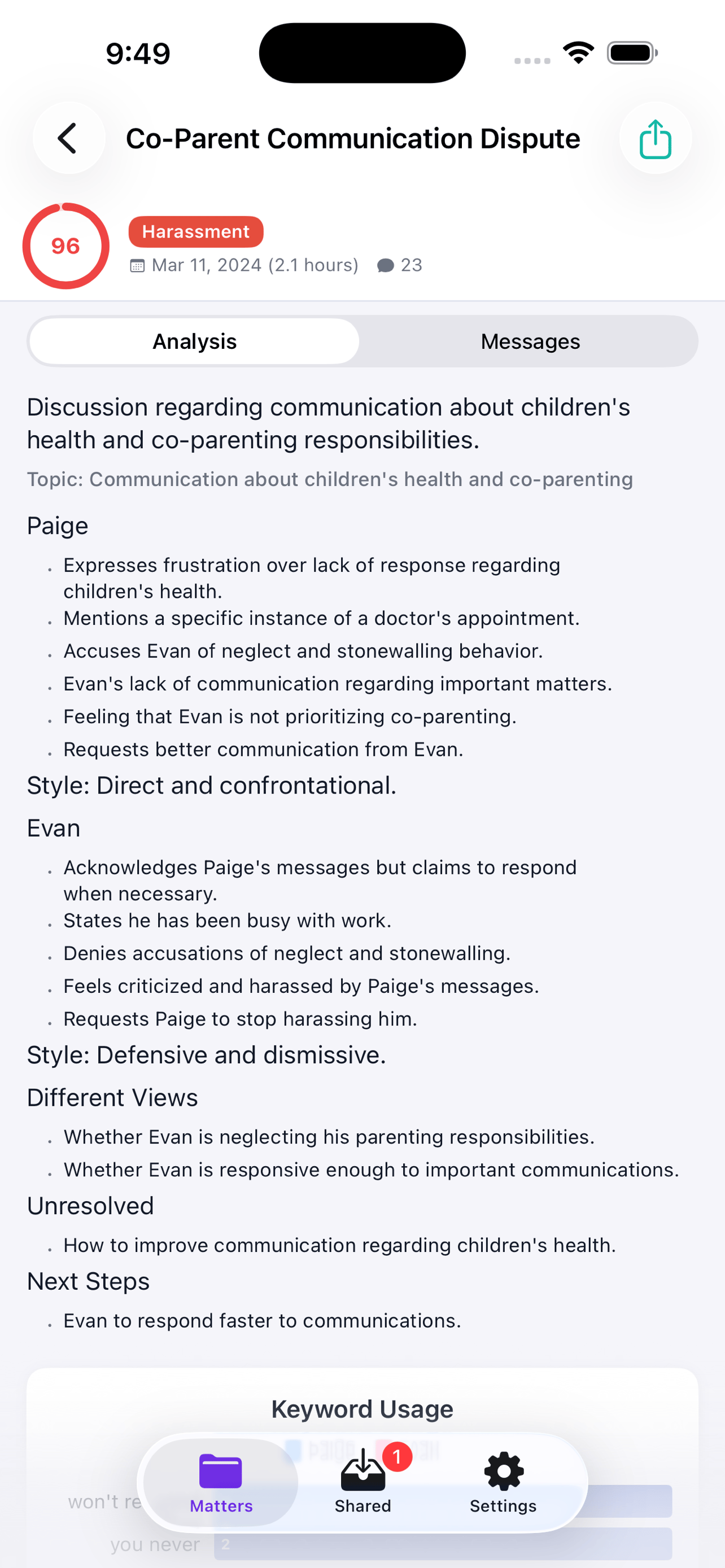
Your client sends you the report. You open it in the free CustodyComms iPhone app: every message, every incident, every PDF, searchable, behind a passcode, read-only, with no subscription to view and nothing to install on a firm workstation.
You can also open the same report in your browser, with no app at all, from the link your client sends.
A case rundown PDF rides inside the same bundle: a working chronology of the matter, sitting in Source Documents next to the messages it was built from.
Free to view, behind a passcode, encrypted.
What you file comes from Evidence Edition, the $149 month in which the record is built, on Mac or Windows. Your paralegal reviews the same artifact whether the client ran that month or your firm did. One document, six evidentiary safeguards.
Every file and every message record is hashed at import. The manifest ships with the packet. Tamper evidence before your firm touches it.
One numbering scheme across iMessage, Gmail, OFW, AppClose, WhatsApp, and Messenger. Cite by Bates number, not by platform.
Every message cites its originating app and original timestamp. No mystery exhibits in the trial binder.
The certification block comes filled in. A qualified signer executes electronically, right inside the app, and the exhibit supports self-authentication when signed by a qualified person. ESIGN-compliant disclosures are included.
Before the PDF is written, every source file is hashed again against its original SHA-256. Tamper evidence before the packet ever leaves the custodian’s machine.
Timestamped record of every import, edit, and export. Exportable as its own exhibit on request. Backed up to two locations automatically.
Firms that run this stage themselves license it by headcount instead: seats for attorneys and paralegals, volume on Matters, client-facing branding, and a named support contact. Firm Licensing is priced by contact.
A client can run a Message Review on their own phone, in the browser, before they sit down with you. Nothing to install, no firm seat, and no subscription of yours.
Message Review runs at custodycomms.com/try. The client drops in the export OurFamilyWizard, TalkingParents or AppClose already gives them, or pastes a stretch of messages.
Evidence Edition Lite is $29 a month, one person per plan, and the client buys it directly. It covers the months before the export; the month the record is built is Evidence Edition at $149. Both plans are month to month, so a client can subscribe for the month they need and cancel. Your firm has nothing to procure and no seat to manage.
The client sends it to the email address you give them, from the phone they ran it on.
The free CustodyComms iPhone app opens what was shared with you: every incident, every message inside it, searchable and read only. No desktop, and nothing to install on a firm workstation.
Message Review is the one part of CustodyComms that is not local. The export the client drops in is uploaded to us, and the text extracted from it is sent to OpenAI to produce the analysis. The Privacy Policy says so in its own words: “It is the only feature where a complete conversation is uploaded to us and processed in readable form.” The upload is deleted within 24 hours unless the client sends the report to their phone, and the file name is never recorded. Per OpenAI’s API terms, that traffic is not used to train models.
The desktop app is the opposite and stays that way: imports, analysis and the export itself run on the client’s own computer. If a matter should not have a conversation uploaded at all, the client can skip Message Review and start in the desktop app instead.
Read the Privacy Policy for the retention detail and the regions where Message Review is offered, and the security page for how a share is encrypted.
A rough estimate based on your inputs. Real savings depend on matter mix and rates.
14.4 hours recovered
$5,040
Every input, including the reduction, is your own assumption. Your actual results will vary.
Our detection model uses 18 keyword categories derived from family law case review and the Gottman “Four Horsemen” framework. The white paper documents methodology, precision, and limits.
Request the white paperCustodyComms provides formatting and documentation tools. Authentication and presentation decisions remain with the attorney of record.
